

 aiscript.blog
Dear readers, today we will know what AI is and how it works. If you read it completely, you will get an idea about what can be done with this AI. First, we will know about the history of AI.
History of AI:Today we will try to give you a clear idea about the complete history of AI. Here is a clear, step-by-step summary of the history of artificial intelligence (AI), from the initial concept to modern advancements:
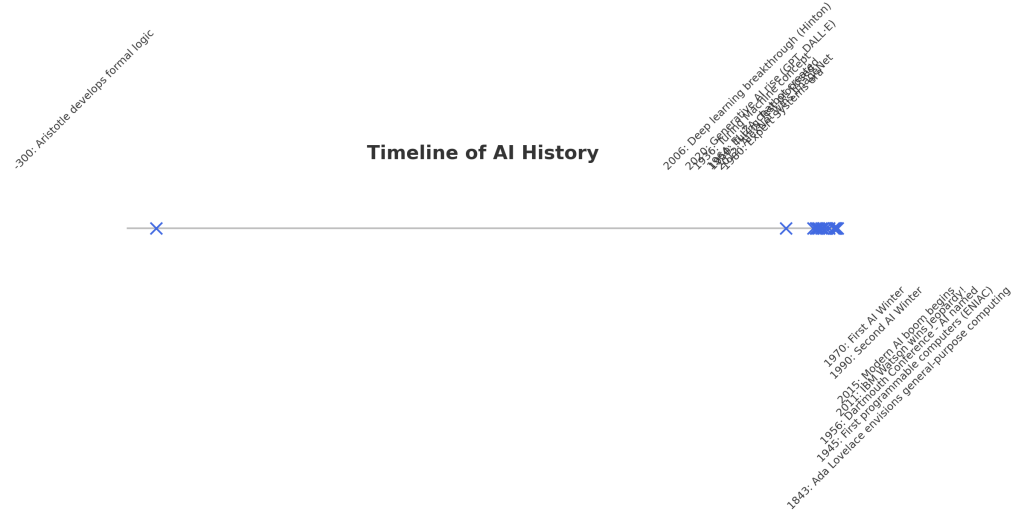
1. Ancient and early concepts (before 1900)• Mythology and philosophy: Ancient myths of Greece, China and the Middle East talked about mechanical creatures or artificial slaves (for example, Talos in Greek mythology).
Philosopher: Aristotle created formal logic (around 300 BC), which laid the foundation for the system of reasoning.• Automata: Early mechanical “robots” like the Hero of Alexandria’s self-propelled machine (~10–70 AD).2. Foundations of Computing (1900–1940)
• Mathematics and Logic: 1843: Ada Lovelace theorizes machines that use symbols beyond numbers.• 1936: Alan Turing introduces the concept of the Turing machine, a theoretical basis for computation.
• Cybernetics: Early ideas about feedback systems and control (Norbert Wiener, 1940)
.• First computers: ENIAC (1945) and other wartime computers showed that machines could follow logical instructions.
3. Birth of Artificial Intelligence as a Field (1950–1960)• 1950: Turing proposes the Turing test to assess the intelligence of machines.
• 1956: Dartmouth Conference (John McCarthy, Marvin Minsky, Allen Newell, Herbert Simon) officially declared artificial intelligence a field of research.Early programs:• Logic Theorist (1955) – solved mathematical proofs
.• Eliza (1964) – early chatbot modeled after a psychotherapist.• Perceptron (1958) – early neural network model.4. Early optimism and the possibility of early AI (1960s–1970s)
• Researchers believed that human-level artificial intelligence (AI) was close, but computers lacked the speed and memory.Limited progress led to a decline in government funding – leading to the first AIs beginning in the 1970s.
5 Expert Systems and the Potential of Second AI (1980s-1990s)Expert Systems: Programs like MYCIN used rules to simulate expert decision-making.Businesses invested heavily in AI for automation.Second AI: Funding again declined due to the high cost and limitations of rule-based systems
.6. Machine Learning and Big Data Era (2000-2010)The growth of the Internet, powerful GPUs, and vast datasets revitalized AI.Key Developments:2006: Geoffrey Hinton’s breakthrough in deep learning.2011: IBM Watson wins Jeopardy! against human champions.2012: AlexNet’s victory over ImageNet demonstrates the power of deep learning.
7. Modern AI Boom (2015–present)Natural Language Processing (NLP): GPT, BERT, and other models have revolutionized language understanding.Computer Vision: AI surpasses human accuracy in many image recognition tasks.Generative AI: Tools like DALL·E, ChatGPT, and Midjourney generate text, images, and music.Applications everywhere: Healthcare, self-driving cars, robotics, finance, and personal assistants.
8. Future Trends:Research into AGI (Artificial General Intelligence) is ongoing.Ethics and Regulation: Focus on fairness, reducing bias, and developing safe AI.Human-AI Collaboration: Emphasize AI as a partner, not just a tool.OpenAI History:Here is a clear and detailed history of OpenAI, from its founding to its recent developments:OpenAI Founding – 2015:December 11, 2015 – OpenAI was founded as a non-profit AI research organization.Founders: Elon Musk, Sam Altman, Greg Brockman, Ilya Sutskever, Wojciech Zaremba, John Shulman, and others.Goal: To ensure that Artificial General Intelligence (AGI) is beneficial to all of humanity.Initial funding: Over $1 billion pledged (with major contributions from Elon Musk and Sam Altman).2016-2018 – Initial research and tools:
• Focused on open-sourcing AI research and publishing.• OpenAI Gym (a toolkit for reinforcement learning) and OpenAI Baseline released.2018 – Dota 2-playing AI (OpenAI Five) is created, which can compete against pro-human teams.2019 – Shifts to “capped-profit”:OpenAI transitions from a fully non-profit organization to a “capped-profit” model, forming OpenAI LP to attract investment while maintaining a mission-driven charter.Microsoft invests $1 billion, becoming a key partner for cloud computing.GPT-2, a powerful language, is released



I stumbled upon strv123b the other day and I was pleasantly surprised. The site is clean, the loading times are fast, and everything felt smooth. Give it a try y’all!
Thank you bro